







By using our website, you agree to the use of cookies as described in our Cookie Policy
Minibus Charter vs. Full Charter Bus for Group Transportation in DC
Most people think group transportation is just about fitting bodies into seats. But DC's streets don't care about your headcount—they care about maneuverability, timing, and whether your vehicle can actually get where you need to go. A minibus and a full charter bus might both move people, but they don't move the same way. And if you pick wrong, you're stuck dealing with delays, wasted money, or a driver circling the block because your bus won't fit.
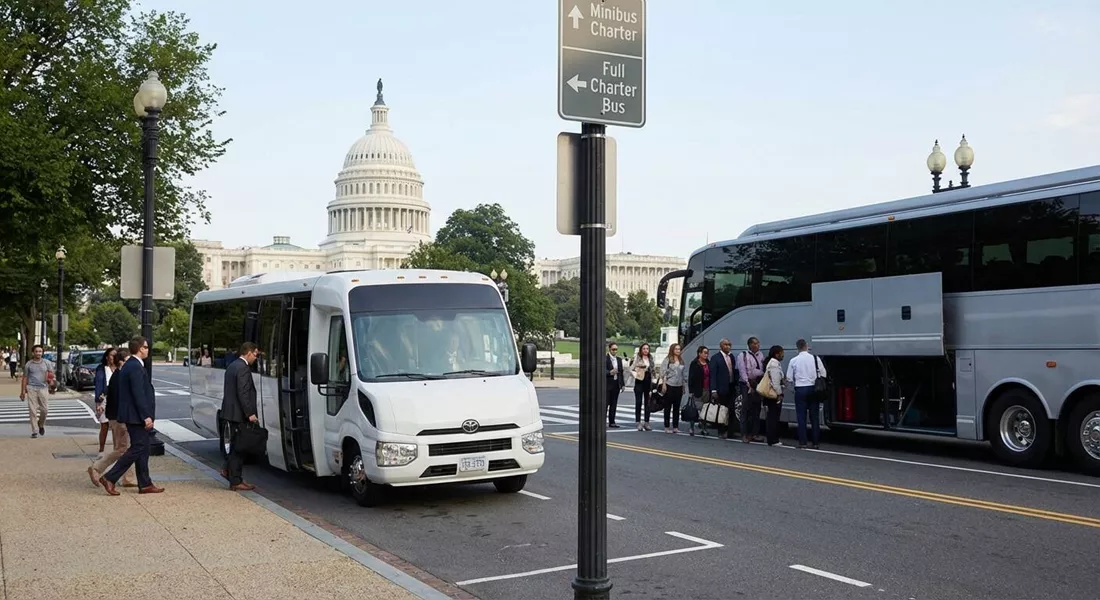
what matters. Group size is obvious, but it's not the only factor. You need to think about where you're going, how tight the schedule is, and whether your passengers need space to spread out or just a quick ride across town. Every route has constraints. Every vehicle has limits. And every decision should be grounded in what actually works for your group—not just what sounds good on paper.
Size Dictates More Than You Think
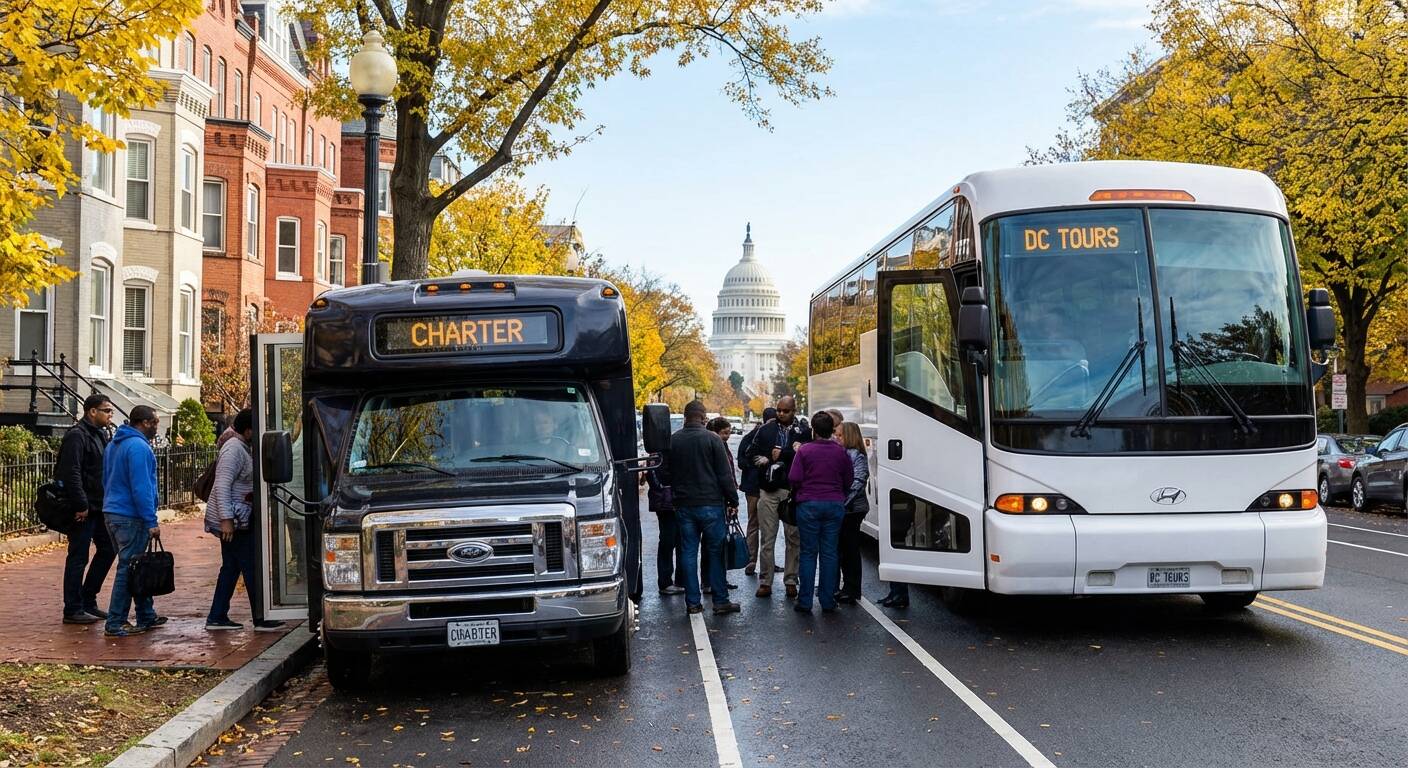
A minibus holds anywhere from 18 to 35 passengers, depending on the model. That's enough for a corporate outing, a wedding shuttle, or a mid-sized tour group. The footprint is smaller, the turning radius tighter, and the driver can squeeze into spots a full-size coach would never attempt. If your itinerary includes narrow Georgetown streets or last-minute stops near the monuments, that agility pays off.
A full charter bus seats 40 to 56 people, sometimes more. It's built for volume, not nimbleness. The interior is spacious, the luggage bays are deep, and the amenities—restrooms, reclining seats, overhead bins—are designed for longer hauls. If you're moving a convention group, a school trip, or a multi-stop tour with serious gear, the extra capacity matters. But that size comes with trade-offs, especially in a city where parking is scarce and traffic is relentless.
Navigating DC's Layout
Washington isn't built for oversized vehicles. The streets around Capitol Hill, Dupont Circle, and the Wharf are tight. Parking near the Smithsonian or the Tidal Basin? Forget it unless you've coordinated ahead. A minibus can slip into loading zones, make quick turns, and handle last-minute route changes without the drama. That flexibility matters when your schedule is packed and your group doesn't have time to walk three blocks from where the bus had to park.
Full charter buses need space—lots of it. They're better suited for highway runs, airport transfers, or events where you can stage the vehicle in a designated lot. If your group is heading to a venue with coach parking or you're doing a straight shot from one location to another, the size isn't a problem. But if you're hopping between museums, restaurants, and monuments, that bus becomes a liability fast.
What You're Actually Paying For
Minibus charters cost less upfront because they burn less fuel, require less maintenance, and don't need as much real estate to operate. If your group is under 30 people, you're not paying for empty seats. The pricing is straightforward, and the per-person cost usually makes sense without a lot of mental math.
Full charter buses look expensive until you divide the rate by 50 passengers. Then the numbers flip. If you've got the headcount to fill the seats, the per-person cost can actually beat a minibus. But if you're only filling half the bus, you're subsidizing air. And if the route requires extra permits, tolls, or staging fees because of the vehicle's size, those costs add up fast.
Amenities That Actually Matter
Minibuses keep it simple. You'll get air conditioning, comfortable seating, and sometimes Wi-Fi or charging ports. That's enough for most trips under two hours. The focus is on getting people from point A to point B without fuss. If your group doesn't need a rolling lounge, the stripped-down approach works fine.
Full charter buses come loaded. Restrooms, entertainment systems, extra legroom, overhead storage—these aren't luxuries if your trip is long or your passengers need to work, relax, or store luggage. For multi-day events, conference shuttles, or cross-state travel, those features justify the upgrade. But for a quick loop around the National Mall? You're paying for amenities no one will use.
When Timing Drives the Decision
Minibuses load and unload faster. Fewer passengers mean less chaos at each stop. If your itinerary is tight and you're hitting multiple locations in a short window, that efficiency compounds. Every minute saved at a curb is a minute you're not stuck in traffic or scrambling to stay on schedule.
Full charter buses take longer to board, especially if passengers are hauling bags or settling into assigned seats. If your event has built-in buffer time or you're only making one or two stops, the delay isn't a big deal. But if you're running a tight schedule with back-to-back pickups, the slower pace can throw everything off.
Matching the Vehicle to the Event
We've seen groups make the wrong call more times than we can count. Here's where each option actually shines:
- Corporate outings with 20 to 30 people? Minibus keeps it professional and efficient.
- Wedding shuttles between hotel and venue? Minibus handles the route without drama.
- School field trips with 50 students? Full charter bus gives you the capacity and supervision space.
- Convention shuttles running all day? Full charter bus handles volume without constant swaps.
- Multi-stop tours with tight parking? Minibus navigates the city without the headache.
Driver Experience and Route Knowledge
Both vehicle types come with professional drivers, but the skill set shifts depending on the bus. Minibus drivers need to be sharp with city navigation—quick decisions, tight turns, and constant awareness of pedestrian zones. Full charter bus drivers need to manage larger vehicles, plan routes around height and weight restrictions, and coordinate staging logistics ahead of time.
Either way, you want a driver who knows DC. The traffic patterns, the construction zones, the spots where tourists clog the streets—local knowledge makes or breaks the experience. A driver who's just following GPS is going to cost you time and patience.
Safety Standards Don't Change
Minibuses and full charter buses are both held to the same federal safety regulations. Regular inspections, licensed drivers, insurance coverage—none of that varies by vehicle size. What does change is how the vehicle handles in different conditions. A minibus is easier to control in tight spaces. A full charter bus is more stable on highways. Both are safe when operated correctly, but the environment matters.
Booking Smart Means Asking the Right Questions
Don't just call and ask for a quote. You need to know what you're getting and what you're giving up. Here's what to clarify upfront:
- What's the exact passenger capacity, and does that include luggage space?
- Are there route restrictions based on vehicle size or permits?
- What amenities are included, and which cost extra?
- How does pricing change if you add stops or extend the rental time?
- What's the cancellation policy if your plans shift?
Common Mistakes That Cost Time and Money
Groups underestimate how much space they actually need. They book a minibus for 30 people and forget about the luggage, the coolers, or the equipment. Then they're scrambling to fit everything in or paying for a second vehicle. If your group is close to the capacity limit, round up—not down.
Others overbook. They reserve a full charter bus for 25 people because it sounds impressive, then realize they're paying double what a minibus would have cost. The extra space doesn't add value if no one's using it. Match the vehicle to the actual headcount, not the aspirational one.
Flexibility Isn't Guaranteed
Both options let you customize routes and schedules, but full charter buses have more constraints. Some streets are off-limits. Some venues don't have coach parking. Some routes require advance permits. If your itinerary is fluid or you're planning last-minute changes, a minibus gives you more room to adjust without reworking the entire plan.
Documentation Keeps Everyone Aligned
Get everything in writing. The pickup times, the route, the amenities, the pricing—all of it. If the company says the bus has Wi-Fi, make sure it's in the contract. If they promise a specific vehicle type, confirm it before the day of. Miscommunication is the fastest way to turn a smooth trip into a disaster.
We've also seen groups skip the walkthrough. They assume the bus will show up as described, then find out it's an older model or missing features they were counting on. Ask for photos. Ask for specs. Ask for references if you're booking a high-stakes event.
What Happens When Plans Change
DC traffic is unpredictable. Events run late. Passengers miss the departure time. A good charter company builds buffer into the schedule and has contingency plans for delays. A bad one charges you extra for every minute over and leaves you stranded if something goes wrong.
Ask how they handle changes. What's the policy if you need to extend the rental? What happens if the driver hits traffic and you're running behind? The answers tell you whether you're working with a company that understands logistics or one that's just filling seats.
Why Most Groups Get This Wrong
They focus on price instead of fit. They pick the cheapest option without thinking about whether it actually works for their route, their timeline, or their group size. Then they end up paying more in the long run—either through add-on fees, wasted time, or a second booking to fix the first mistake.
The right vehicle isn't the one with the lowest rate. It's the one that gets your group where they need to go, on time, without drama. That's the calculation that matters.
Picking the Right Partner
At the end of the day, the vehicle is only as good as the company behind it. We've worked with thousands of groups moving through DC, and the ones who have the smoothest experience are the ones who ask questions, plan ahead, and choose a provider who knows the city inside and out.
Whether you need a minibus or a full charter bus, the decision should be based on what actually works—not what sounds good in theory. Get clear on your group size, your route, and your priorities. Then book the vehicle that fits, not the one that's easiest to sell.
Let’s Make Your DC Trip Effortless
Group travel in DC doesn’t have to be complicated. When we match the right bus to your needs, everything runs smoother—no missed stops, no wasted time, just a trip that works for everyone. If you’re ready to get your group moving with zero hassle, let’s talk through your options. Call us at 844-870-4517 or get your free quote and we’ll help you plan transportation that actually fits your itinerary.
‹ Back
Recent Posts
-
When Does a Passenger Van in DC Make Sense?
October 20, 2026
-

Making Corporate Transportation in DC Easier for Busy Workdays
October 6, 2026
-

Choosing a Charter Bus in DC for Large Group Outings
September 22, 2026
-

How Can Seniors Get Around DC Without a Car?
September 8, 2026
-
What Is the Best Transportation in Washington DC?
August 25, 2026